
Case study: a plastic-free skincare brand seals boxes with kraft tape
A small skincare brand in Hyderabad writes "plastic-free packaging" on its website. Then a customer opens the carton, peels off a strip of shiny brown tape, and asks a fair question in the comments. Is this tape plastic?
It is. Brown BOPP tape is polypropylene film with glue on one side.
This is a worked example. The business is illustrative, put together from situations small sellers commonly face. The product details and the maths are real.
The short answer for this brand: switch the carton tape to our brown kraft paper tape, 48 mm x 50 m, and test it on your own cartons for two weeks before the full change. Then check every other item in the parcel, because the tape is only one of them. At about 350 orders a month, the brand needs roughly 11 rolls a month.
Who is the seller, and what is in the parcel?
The brand is three people and a rented flat that doubles as the packing room. It sells through its own website and Instagram, about 350 orders a month. The range is face creams in glass jars, serums in glass dropper bottles, and bar soaps in paper sleeves. Roughly 7 orders in 10 have glass in them, and the rest are soap only.
If I were in their place, I would not start with the tape. I would start by tipping one packed order out on the table and writing down every piece.
| Item in the parcel | What it is usually made of | Plastic-free? |
|---|---|---|
| Shipping carton | Corrugated board | Yes |
| Wrap around each jar | Honeycomb paper | Yes |
| Gap filler | Crumpled paper | Yes |
| Carton tape, today | BOPP film | No |
| Carton tape, after the switch | Kraft paper tape | Yes |
| Shipping label | Thermal label | Check that your label stock is paper, not a film |
| Invoice | Paper, loose in the box | Yes. Our packing list envelopes are polyethylene, so they would break the promise |
| Jar lids, dropper bulbs, pumps | Often plastic or rubber | Often no |
This table is the whole case in one picture. Changing the tape fixes one line. The product line at the bottom may stay as it is, and that matters for what the brand says later.
Why kraft paper tape, and what else could they use?
There are four sensible routes, and I want to be fair to each.
- Keep brown BOPP tape. It is cheaper per carton, holds well on most boxes, and our 65 m roll goes further than a 50 m paper roll. If the brand did not promise plastic-free, I would tell them to stay on it.
- Water-activated gummed paper tape. It is also paper, and it bonds firmly into the fibres of the board. But it needs a wet dispenser and some practice, and we do not sell it.
- A box that needs no tape at all, such as a self-locking mailer box. That is a carton decision, and it may cost more per order.
- Self-adhesive kraft paper tape, which we sell in packs of 1, 12 and 24 rolls. No water, no special machine. It runs on any standard 2 inch dispenser, tears by hand, and goes out with paper waste.
The brand picks option 4, because nothing else changes on the packing table.
I have put BOPP and kraft side by side in kraft paper tape vs BOPP tape, so I will not repeat it here.

Where will kraft tape struggle in Hyderabad?
We make packaging tape at JPPL in Jaipur, and I will be straight with you. Paper tape is less forgiving than plastic tape. There are three places where I would expect trouble.
- Recycled or dusty cartons. Some recycled board sheds loose fibre and dust on its face. The glue grips the dust, and the dust grips nothing. Wipe the board with a dry cloth and press the tape down hard.
- Glossy, laminated or coated boxes. Paper tape holds best on plain cardboard and kraft board. On a shiny box, test one strip first. (For a plastic-free brand, a laminated box is a contradiction anyway.)
- Humidity. Paper and damp do not get along. Hyderabad's monsoon months are humid, and rolls left open near a window or a wet wall pick it up. Keep the rolls in a closed carton on a shelf, and keep damp cartons away from the packing table.
So before the switch, I would run a simple two-week test:
- Buy 1 roll and tape 20 real orders with it, half on the brand's usual cartons and half on any recycled stock.
- Keep 3 extra packed cartons in the packing room for 7 days, and check every morning whether any strip end has lifted.
- Ask one friendly customer a day to send a photo of the carton when it arrives.
- If a strip lifts, note the carton type and the weather that day before you blame the tape.
How is each order packed?
- Fold the bottom flaps of a 20 x 15 x 10 cm carton and turn it upside down.
- Run the H pattern on the bottom: one strip along the centre seam and one across each end, each running about 6 cm down the side.
- Rub every strip down with your palm, end to end. Self-adhesive tape sticks with pressure.
- Wrap each glass jar or bottle in honeycomb paper. Our guide on packing fragile orders without plastic covers the wrap and the fill.
- Fill the gaps with crumpled paper, close the flaps and shake the box. If you hear movement, add paper.
- Put the paper invoice on top, inside the box.
- Tape the top with the H pattern for glass orders, or one strip for soap-only orders.
- Stick the label flat on the top face and keep tape off the barcode.
Our step-by-step on how to tape a shipping carton explains why the bottom goes first.
How many rolls a month?
For a 20 x 15 x 10 cm carton, the full H pattern on both faces takes about 1.72 m of tape. One strip on the top and bottom takes about 0.64 m. I have added about 10% for bad cuts and the last turn on the core.
| Order type | Orders a month | Tape per carton | Metres a month |
|---|---|---|---|
| Glass jar or bottle orders, H both faces | 245 | 1.72 m | about 421 m |
| Soap-only orders, one strip top and bottom | 105 | 0.64 m | about 67 m |
| Subtotal | 350 | about 488 m | |
| With 10% waste | about 537 m |
537 m divided by 50 m per roll is about 10.75, so call it 11 rolls a month. One 50 m roll seals about 29 glass orders before waste.
Now the honest comparison. The same 537 m in our 65 m BOPP rolls would be about 8 or 9 rolls. A kraft roll is 50 m against 65 m, so for the same work the brand needs about 30% more rolls, and each kraft roll also costs more. See the listings for today's prices before you decide.
The buying plan is simple. Take 1 roll from us for the test. After that, a pack of 24 every two months covers 22 rolls of use with 2 spare. If storage is tight in the monsoon, take a pack of 12 every month instead, so fewer rolls sit around in damp air. The cart takes 5%, 7% or 10% off above Rs 1,000, Rs 2,000 or Rs 3,000, so add the month's honeycomb paper from our honeycomb papers range to the same order.
What should the brand say, and what should it watch?
In October 2024, India's Central Consumer Protection Authority issued guidelines on greenwashing and misleading environmental claims. They cover claims about a product, a component or its packaging, and they say words like "green" or "eco-friendly" need clear qualifiers and proof.
So I would ask the brand to be exact. "Our outer packaging is paper: carton, wrap, fill and tape" is true after this switch. "Our parcel is plastic-free" is true only if the jar lids, droppers and labels are plastic-free too. If they are not, say what is and what is not. Customers respect that more than a big word.
Then measure it for 60 days before and 60 days after the switch:
- Count orders that arrive with the tape lifted or the carton open.
- Count customer messages asking about plastic in the packaging.
- Note which carton batch and which week any failure came from.
If failures cluster on one carton batch, change the carton, not the tape.
What would it take in your business?
- Tip out one packed order and list every item and its material.
- Decide what your claim actually covers, and write it down in one sentence.
- Buy 1 roll of kraft tape and run the two-week test on your own cartons.
- Work out your metres a month: orders, times tape per carton, plus 10%.
- Divide by 50 for kraft rolls. Expect about 30% more rolls than with 65 m BOPP.
- Find a dry, closed place for the rolls before the monsoon.
A question brands ask
Can you print our logo on kraft paper tape?
Our standard logo printing is on 48 mm brown or clear packing tape, which is BOPP, so it would break a plastic-free promise. For printed kraft tape, write to us with your quantity and we will tell you what is possible. Until then, a rubber stamp or a paper sticker on the carton keeps the branding in paper.
Write to us with your carton size and monthly orders, and we will help you work out the roll count before you buy the first pack.
Products in this guide
Prices include 18% GST. Free delivery across India on every order.
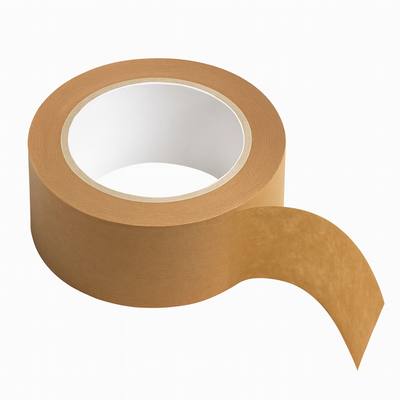 Kraft Paper Tape 48 mm x 50 m, Self-Adhesive
From ₹349 incl. 18% GST3 pack optionsView & buy
Kraft Paper Tape 48 mm x 50 m, Self-Adhesive
From ₹349 incl. 18% GST3 pack optionsView & buy
 Honeycomb Paper Sheets 390 x 500 mm for Packing
From ₹349 incl. 18% GST
Honeycomb Paper Sheets 390 x 500 mm for Packing
From ₹349 incl. 18% GST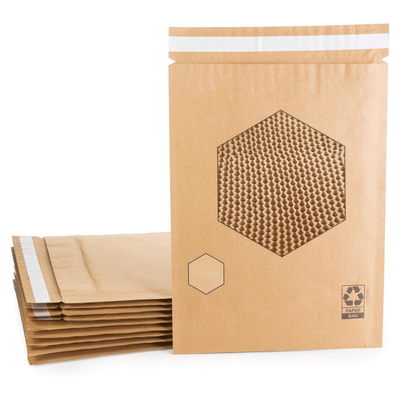 Honeycomb Padded Paper Mailers, Self-Seal
From ₹289 incl. 18% GST
Honeycomb Padded Paper Mailers, Self-Seal
From ₹289 incl. 18% GST


