
Case study: packing earrings and lipsticks with honeycomb mailers
A pair of jhumkas arrives with one hook bent flat. A compact powder arrives with a cracked mirror. A lipstick carton arrives crushed at one corner. In the courier's books, none of these parcels is damaged. For a small jewellery brand, each one is a customer who may not order again.
This is a worked example. The business is illustrative, put together from situations small sellers commonly face. The product details and the maths are real.
Here is the short answer. If I were packing for this brand, I would ship almost every order in honeycomb paper mailers, in just three sizes: M1 for earrings, M2 for cosmetics and M3 for gift combos. Every piece goes into its own box or pouch first. Anything in glass, and anything that is a flammable liquid, leaves the mailer system and goes into a carton.
Who is the seller, and what is going wrong?
The example brand is a three-person studio in Kolkata. The founder makes handmade earrings: terracotta, beaded and oxidised pieces. Alongside them, the brand sells a small range of cosmetics in plastic packs, mostly lipsticks, kajal pencils, lip balms and pressed compacts.
They ship about 300 orders a month. Most come through Instagram and their own website, with a few repeat buyers ordering on WhatsApp.
Today every order goes into a plain plastic courier bag with a strip of plastic bubble wrap around it, taped shut. Two things go wrong with that setup.
- A courier bag has no stiffness. In a sack full of heavier parcels, earring hooks bend and small cartons get pressed at the corners.
- The brand calls itself low-waste on Instagram, and customers notice when a handmade terracotta earring arrives wrapped in two layers of plastic.
Why honeycomb mailers, and what else did they consider?
They looked at three other options first. Each one wins somewhere.
- Plastic bubble mailers. Light, cheap and better in rain than paper. But the customer sees plastic first, and that breaks the brand's promise.
- Small cartons with crinkle paper. The best unboxing for gift orders, and the right home for anything in glass. But every order takes a few more steps, and cartons eat shelf space in a small studio.
- Plain courier bags, as today. Cheapest and waterproof, with no cushioning at all. I would still keep a stack of these, for reasons I will come to.
Our honeycomb paper padded mailers sit in the middle. They have kraft paper outside, honeycomb paper padding inside and a self-seal strip, so there is no tape to cut. After use, the listing says, they are recyclable with paper waste. We sell them in six sizes, M1 to M6, in packs of 10, 50 and 100, and we would always ask a new buyer to start with 10.
Think of a sandesh box from a Kolkata sweet shop. Each sweet sits in its own paper cup, and the box keeps the cups from being squashed. The mailer is the box. The pouch or small carton around each earring is the cup.
You need both.
If the brand were still deciding between paper and plastic in general, I have compared the two in padded paper mailer or plastic courier bag.

Which mailer size goes with which order?
The rule I use is simple. Measure the product as it ships, in its box. Add its thickness plus about 1 inch to both the width and the length. Pick the first mailer that covers both numbers. If the result lands within half an inch of a size, go one size up, because the honeycomb padding takes some of the room inside.
Our size names, M1 6x9 up to M6 15x19 inches, describe the space to plan with. The size chart photo on the listing shows slightly bigger outside numbers. Plan with the size name.
The measurements below are typical for this kind of brand. Measure your own.
| Order type | As it ships (inches) | Space needed | Mailer |
|---|---|---|---|
| One pair of earrings in a small kraft box | 3 x 3 x 1 | 5 x 5 | M1 (6x9) |
| Two earring boxes side by side | 6 x 3 x 1 | 5 x 8 | M1 (6x9) |
| Three cosmetics wrapped together in paper | 5 x 6 x 1.25 | 7.25 x 8.25 | M2 (9x11), because M1 is too narrow |
| Gift combo box: earrings plus 2 cosmetics | 6 x 8 x 2 | 9 x 11 | M3 (10x13), because 9 x 11 is exactly M2 with no room to spare |
So this brand needs only three sizes.
That matters more than it sounds. Every extra size is another shelf, another reorder and another chance of picking the wrong one.
How does the packing setup work, step by step?
- Push each earring through a small card (and fit the backs on studs), so the pair cannot tangle or bend. Put the card in a pouch or a 3 x 3 inch kraft box.
- Keep cosmetics in their own retail cartons. When an order has two or three items, wrap them together in one sheet of plain paper so they move as one block.
- Fold the invoice and lay it on top of the product, inside the mailer. Our mailers have no invoice pocket.
- Slide everything to the bottom of the mailer. Leave about a finger's width between the product and the fold line of the flap.
- Shake the mailer gently. If something slides end to end, add a little crumpled paper.
- Peel the liner, fold the flap straight and press the strip from the centre outwards. Run your thumb along it once more.
- Stick the shipping label flat on the front face, away from the flap and the edges.
I have written the full method, with more detail on seals and labels, in how to pack in padded paper mailers.
How many mailers a month, and when to reorder?
This is where a small brand usually guesses.
Let us do the maths instead.
Assume the 300 orders split like this: 60% earrings only, 25% cosmetics only and 15% gift combos. Your split will differ, so take it from last month's orders. I add about 5% spare for mistakes, torn liners and the occasional wrong pick.
| Size | Orders a month | With 5% spare | What to buy | Reorder when stock falls to |
|---|---|---|---|---|
| M1 (6x9) | 180 | about 189 | 2 packs of 100 each month | about 95 |
| M2 (9x11) | 75 | about 79 | 1 pack of 100, lasts about 5 weeks | about 40 |
| M3 (10x13) | 45 | about 47 | 1 pack of 50 each month | about 25 |
The reorder point is roughly two weeks of use. At about 26 working days a month, this brand packs around 12 orders a day, so two weeks is about half a month's stock. We dispatch in 1 to 2 working days and delivery is free, but transit time to Kolkata varies by courier, and two weeks of cover leaves room for that.
Count the three stacks every Monday. It takes two minutes, and sellers often tell us they ran out of one size simply because nobody looked.
Buying all three sizes in one monthly order also helps with the automatic cart offers: 5% off above Rs 1,000, 7% above Rs 2,000 and 10% above Rs 3,000. See the listing for today's price per pack.

What should this brand watch out for?
I would watch three things.
- Glass and flammable liquids. Nail polish, perfume and glass roll-ons do not go in a mailer. A mailer softens a knock, but it does not stop a crushing load, and broken glass can cut through paper. Pack these in a carton with wrap and fill, as in packing fragile orders without plastic. Check the courier too. Blue Dart's own Dangerous Goods page (read October 2026) lists flammable liquids among goods it does not accept. Other couriers have their own rules, so ask yours before adding such products to the range.
- The monsoon. Paper and water do not get along, and Kolkata has a long, wet monsoon. I will be honest here. A sealed plastic courier bag keeps rain out better than any paper mailer. For the wettest weeks, this brand could ship to the worst-hit areas in our tamper-proof courier bags, with the earring box inside. That is a trade-off, and the brand should decide it openly.
- Combos that grow. If a gift order sags when you hold the filled mailer by one corner, it has outgrown a mailer. Move it to a carton.
How will the brand know if the switch worked?
Not by feel. Count the complaints about bent hooks and dented cartons for 60 days before the change and 60 days after. Time 20 orders with the old setup and 20 with the new one. Those two numbers will tell them more than any opinion, including mine.
What would it take in your business?
- Write down your three most common order types. Measure each one exactly as it ships.
- Apply the thickness plus 1 inch rule, and go up a size if you land within half an inch.
- Try before you stock up. Our free sample listing has a honeycomb mailer variant at Rs 0. After that, buy a pack of 10 in each size you picked and pack real orders in them for a week.
- Take your monthly orders per size and add about 5%. That is your monthly buy.
- Set your reorder point at about two weeks of use, and count stock on the same day every week.
- Make a list of products that never go in a mailer: glass, liquids with droppers or pumps, anything flammable.
- Decide your monsoon plan before the rains start, not after the first wet complaint.
We make paper packaging at JPPL in our own plant in Jaipur, and a mailer is the simplest way I know for a small brand to take plastic out of one product line first. If you are unsure which three sizes suit your range, write to us with a photo of your most common orders, and we will tell you where I would start.
Products in this guide
Prices are before GST. Free delivery across India on every order.
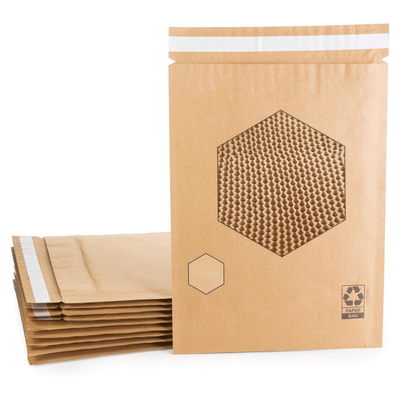 Premium Honeycomb Paper Padded Mailer Eco Friendly Self Seal Padded...
From ₹249 + GST
Premium Honeycomb Paper Padded Mailer Eco Friendly Self Seal Padded...
From ₹249 + GST Courier Bags Tamper Proof | Heavy Duty Plastic Polybags for Safe Sh...
From ₹199 + GST6 pack optionsView & buy
Courier Bags Tamper Proof | Heavy Duty Plastic Polybags for Safe Sh...
From ₹199 + GST6 pack optionsView & buy
 JPPL Packaging Supplies Sample | Bags, Wraps, Cartons & Tapes
₹0 + GST9 pack optionsView & buy
JPPL Packaging Supplies Sample | Bags, Wraps, Cartons & Tapes
₹0 + GST9 pack optionsView & buy


