How much void fill paper does a carton need?
Void fill has one job. It stops the product from moving.
A product that cannot move inside the box cannot build up speed and hit the wall of the box.
So the right amount is not a fixed number of sheets.
It is the amount at which nothing moves and the flaps close with a gentle press. For a 10 x 8 x 6 inch carton with a medium-sized product inside, I would start with about 8 to 12 crumpled sheets of 380 x 250 mm paper, then adjust after a shake test.
We make void fill paper and honeycomb paper in our group's plant in Jaipur, and we sell both on PackSmith. The table further down gives starting points for other carton sizes. Please treat them as starting points to test, not as measured data.
What is void fill paper for, and what is it not for?
Void fill paper fills the empty space around a product. It is not a cushion for the product's own surface.
That difference matters for fragile items. A glass jar needs a wrap first (honeycomb paper or kraft paper bubble sheets), and then void fill around the wrap. If you skip the wrap and rely on crumpled paper alone, the glass still meets a hard edge somewhere. I have explained the wrap side in honeycomb paper vs bubble wrap.
For a T-shirt, a book or a sealed box of tea, void fill alone is usually enough. The product is not fragile. It only needs to stop sliding.
How many sheets does each carton size need?
First, a quick calibration you can do in two minutes. Crumple three sheets the way you will pack them and press them lightly into a 1 litre measuring jug. Count how many sheets fill one litre with your hands. Everybody crumples differently, so this number is yours, not mine.
For the table, I have assumed one loosely crumpled 380 x 250 mm sheet fills about 0.3 to 0.5 litres, and that your product takes up about half the box. If your product takes up most of the box, you need far fewer sheets.
| Carton (inches) | Approx. cm | Box volume | Empty space if product fills half | Sheets to start with |
|---|---|---|---|---|
| 6 x 6 x 6 | 15 x 15 x 15 | 3.4 L | 1.7 L | 4 to 6 |
| 8 x 6 x 4 | 20 x 15 x 10 | 3 L | 1.5 L | 3 to 5 |
| 10 x 8 x 6 | 25 x 20 x 15 | 7.5 L | 3.75 L | 8 to 12 |
| 12 x 10 x 8 | 30 x 25 x 20 | 15 L | 7.5 L | 15 to 25 |
| 14 x 12 x 10 | 35 x 30 x 25 | 26 L | 13 L | 26 to 44 |
| 18 x 14 x 12 | 45 x 35 x 30 | 47 L | 23.5 L | 47 to 79 |
Look at the last two rows.
If a box needs 40 or more sheets of paper, my honest advice is to change the box, not the paper. Most couriers charge by volumetric weight, so a smaller box saves you paper and freight at the same time.
How do I crumple and layer it so it holds?
- Crumple each sheet loosely, to about the size of your fist. A tight, hard ball uses more paper and gives less spring.
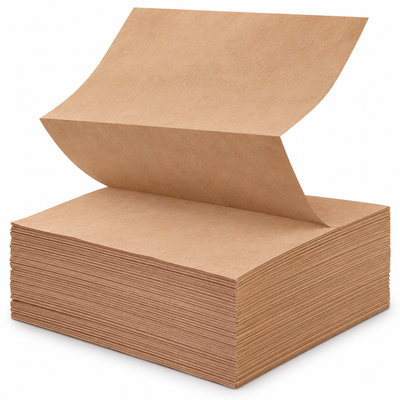
- With fanfold paper, you can also pull out a long strip, bunch it up like an accordion and tuck it in as one piece. It is faster than single balls when the gaps are long and narrow.
- Put a base layer of about 2 to 3 cm in the bottom of the carton before the product goes in.
- Place the wrapped product in the middle, not against a wall.
- Fill the four corners first, then the sides. Corners are where a box takes the hardest knock.
- Add a top layer and close the flaps. They should need a gentle press. If you have to force them, take a sheet out, because too much pressure bulges the carton and pushes on the product.
Then do the shake test.
Hold the closed box with both hands and shake it hard, up and down and side to side. If you hear or feel anything move, open it and add paper.
Where does paper void fill fall short?
I will admit two limits.
First, crumpled paper settles during transit. The repeated small bumps of a truck press it down slowly. A box that is just full at your table can have some play by the time it reaches the customer. So pack slightly firmer than feels necessary.
Second, paper is heavier than air pillows for the same space. For a large, light box, such as a pillow or a soft toy in a 14 x 12 x 10 inch carton, air pillows can be cheaper to ship. Our group company JPPL makes air cushion film and machines, so we know both sides of this choice. We will tell you which one suits your box, even if it is not the paper.
What does void fill cost per carton?
These are PackSmith store prices at the time of writing (October 2026). Delivery is free across India on every order.
| Product | Size | Variants | Store price (incl. 18% GST) |
|---|---|---|---|
| Fanfold void fill paper | 380 x 250 mm, brown | 500 or 1000 sheets | Rs 1,699 and Rs 3,399 |
| Void filling paper | 380 x 250 mm sheets | pack of 500 | Rs 1,649 |
| Crinkle paper | shredded, 6 colours and mixes | 500 g and 1 kg | Rs 469 and Rs 679 |
See each listing for the exact pack contents. To get your own cost per carton, divide the pack price by the number of sheets in it, then multiply by the sheets your box needs. Do it once and write it on the wall above your packing table. We would rather you know your real cost than guess it.
Crinkle paper is sold by weight, so weigh what one gift box takes on a kitchen scale. At Rs 679 for 1 kg, every 50 g costs you about Rs 34. That is useful to know before you put a heaped handful into every hamper.
Two questions sellers ask
Can I use old newspaper instead?
You can, and many sellers do. I would not use it for anything a customer unwraps as a gift. Newsprint ink can rub off on light-coloured products, and a box full of old newspaper does not look like a brand. Plain brown paper costs a little more and solves both problems.
Is crinkle paper enough to protect a fragile gift?
Not on its own. Crinkle paper is mostly for looks and light filling. Wrap the glass or ceramic piece first, then use crinkle paper on top and around it for the unboxing.
For the full packing sequence for glass, ceramics and cosmetics, see how to pack fragile orders without plastic. Pack one box with the table above, shake it, and change the number until nothing moves. Your box will tell you the right answer in a few tries.
Products in this guide
Prices include 18% GST. Free delivery across India on every order.