
Seam Sealing Tape Explained: Types, Specs and How to Test It
Every stitch is a hole.
A rain jacket or a tent has thousands of them, and water will find every single one. Seam sealing tape is the strip that closes those holes after sewing.
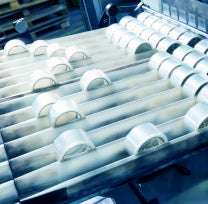
In short, seam sealing tape is a thin plastic film, usually polyurethane (PU), with a layer of hot-melt adhesive on one side. A hot air taping machine melts the adhesive and presses the tape over the stitched seam. Once it cools, the tape works like a small dam over the needle holes, so water cannot come through.
You will find it inside rainwear, tents, footwear, waders, military clothing, diving suits and protective coveralls. During 2020, it became a key part of PPE kits too, because a coverall is only as good as its seams.
How does a hot air taping machine work?
Think of the puncture repair shop near your house. The mechanic roughs the tube, puts a patch, and presses it hard with heat until it bonds. A seam sealing machine does the same thing, only along a seam, continuously, at speed.
The tape runs under a nozzle that blows very hot air onto the adhesive side. Right after the nozzle, two rollers press the softened tape onto the seam. The operator controls three settings:
- Air temperature. Too cold and the adhesive never flows into the fabric, so the tape peels. Too hot and the fabric can shrink or scorch, and the glue squeezes out at the edges.
- Speed. Run too fast and the adhesive does not get enough heat. Run too slow and you overheat it.
- Roller pressure. Too little and the bond stays on the surface. Too much and the seam gets crushed and stiff.
Most bonding problems come from these three dials, not from the tape.
I say this as a tape maker, so take it with a pinch of salt. But I am sure of it. Change one setting at a time and keep notes.
Heat-activated or self-adhesive tape?
Seam sealing tape comes in two broad types.
The heat-activated type is the standard one for hot air machines. The adhesive is dry to the touch at room temperature and bonds only when the machine heats it. Check the maximum temperature on the spec sheet, because a tape with more heat resistance gives you more room on the machine settings.
The self-adhesive type uses hot-melt glue technology and sticks on contact. It suits smaller runs, repairs and places where a machine cannot reach, such as the corner of a bag or a boot. It is simpler to apply.
For garments that get washed again and again, I would still pick the heat-activated type.
How do you read a seam tape spec sheet?
Most buyers look only at width and colour. These are the lines on the spec sheet that tell you how the tape will behave. Ask for every one of them in writing, from any supplier.
- Thickness, in microns. Thicker tape is stronger but makes the seam stiffer.
- Softening point of the adhesive. Below this temperature, the adhesive stays solid.
- Adhesive type. Most are hot-melt adhesives, and the type decides which fabric coatings it bonds to.
- Elongation at break. The tape has to stretch with the fabric when someone bends an elbow or a knee. A tape that does not stretch will crack.
- Tensile strength, usually given in newtons per 25 mm of width.
- UV resistance, in months. It matters for tents and anything else that lives in the sun.
- Colour, width and number of layers. These can often be made to order, and so can a printed logo.
Compare two quotes line by line. If one supplier leaves a line blank, ask why.
How should you test it before a bulk order?
I would never place a bulk order without a trial roll, from any supplier.
Every fabric coating behaves differently. A tape that bonds well on PU-coated nylon may struggle on a laminated non-woven. So test on your own fabric, with your own machine:
- Tape a 1 metre seam and leave it for 24 hours. Then try to peel the tape by hand. It should tear the fabric coating before it lifts cleanly.
- Fill a taped pouch of the fabric with water and hang it for a few hours. Look for wet spots on the outside of the seam.
- Wash and dry the taped sample 5 times, the way your end user would. Then repeat test 2.
- Bend the seam sharply 20 times and look for cracks in the tape.
For regulated products, lab tests apply. In 2020, for example, PPE coveralls in India had to pass a synthetic blood penetration test on the fabric, the garment and the seam, to ISO 16603 class 3 or equivalent, at labs approved by the Ministry of Textiles. If you make protective wear, check the current standard for your product before you choose a tape.
Can you buy seam sealing tape on PackSmith?
No, and I want to be clear about this.
Seam tape is an industrial product bought in bulk by factories. It is not listed on our PackSmith store, which carries packaging tapes for cartons and parcels, like our BOPP and paper tapes.
If you stitch waterproof goods, write to us with your fabric type, machine model and monthly seam length. We will tell you honestly whether we can supply it, and what to ask for in a trial roll.


